Cool Stuff I Made
Interactive visualizations and simulations from engineering projects. The solid at right turns under the drawing convention of the whole site — click it.
How long until the pizza is ready to eat?
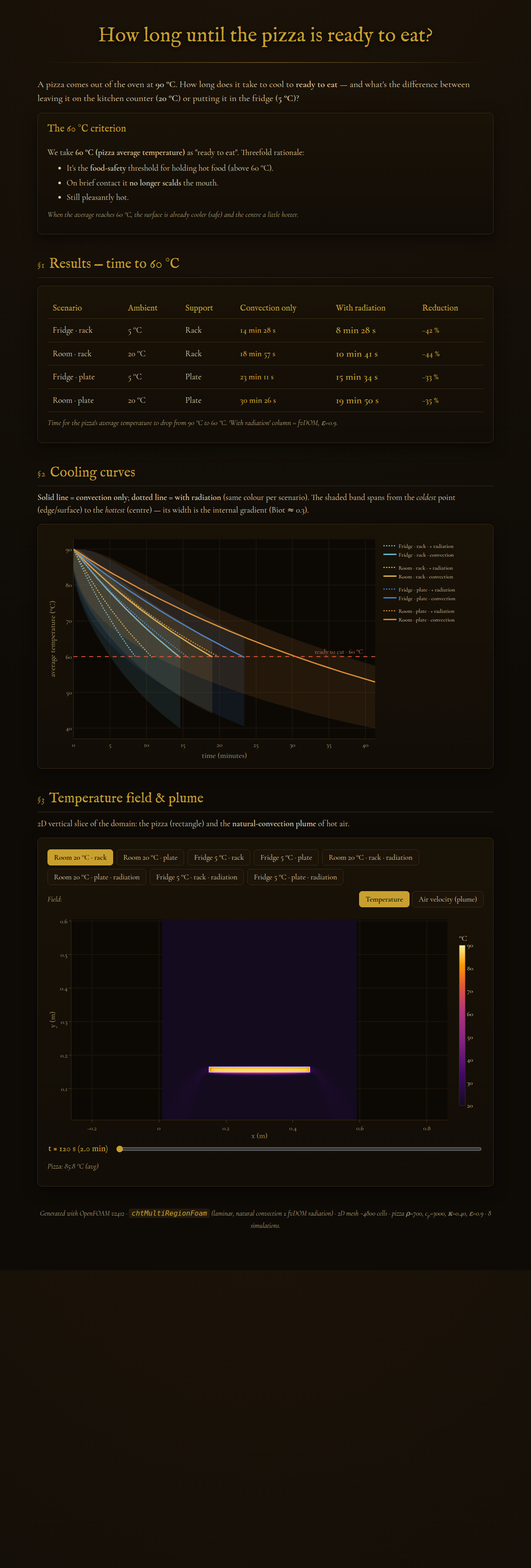
Open the interactive visualization →
A pizza comes out of the oven at 90 °C. How long until it cools to 60 °C — ready to eat — and does it matter whether you leave it on the counter (20 °C) or stick it in the fridge (5 °C)? On a rack or on a plate? I simulated all eight combinations (counter/fridge × rack/plate × with/without thermal radiation) as 2D buoyant-flow cases in OpenFOAM and built this visualization from the resulting temperature fields.
The verdict: fridge + rack + radiation gets you eating in about 8.5 minutes, while a pizza on a plate at room temperature still wasn't at 60 °C when the 25-minute simulation ended. The rack wins because the buoyant plume can pull cool air past the underside; radiation turns out to matter a lot, roughly halving the cooling times.
Stress State Visualizer
Type in the six components of a stress tensor and watch the 3D stress state at a point come alive: the stress cube, principal stresses and their directions, octahedral planes, Mohr's three circles, invariants, the deviatoric tensor, and the von Mises and Tresca yield criteria — all updating live. You can also probe the traction on any plane by pointing its normal. I built it because rotating a stress cube in your head during a Solid Mechanics exam is exactly as hard as it sounds.
N · V · M Diagrams
An interactive beam calculator: choose the supports, set the geometry and loads, and it draws the axial force (N), shear force (V) and bending moment (M) diagrams, with support reactions and a cut section you can slide along the beam to see the internal forces at any point.
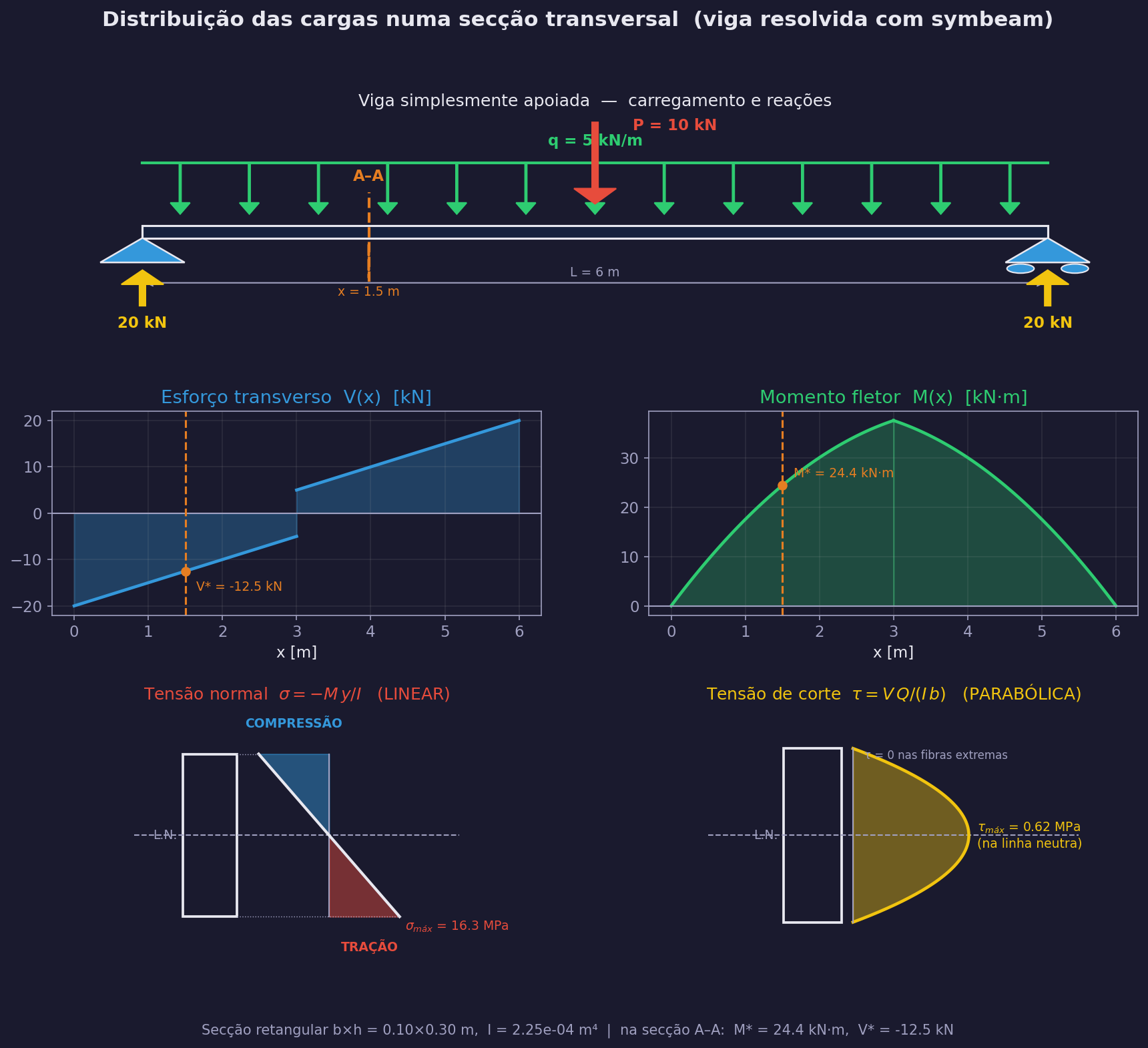
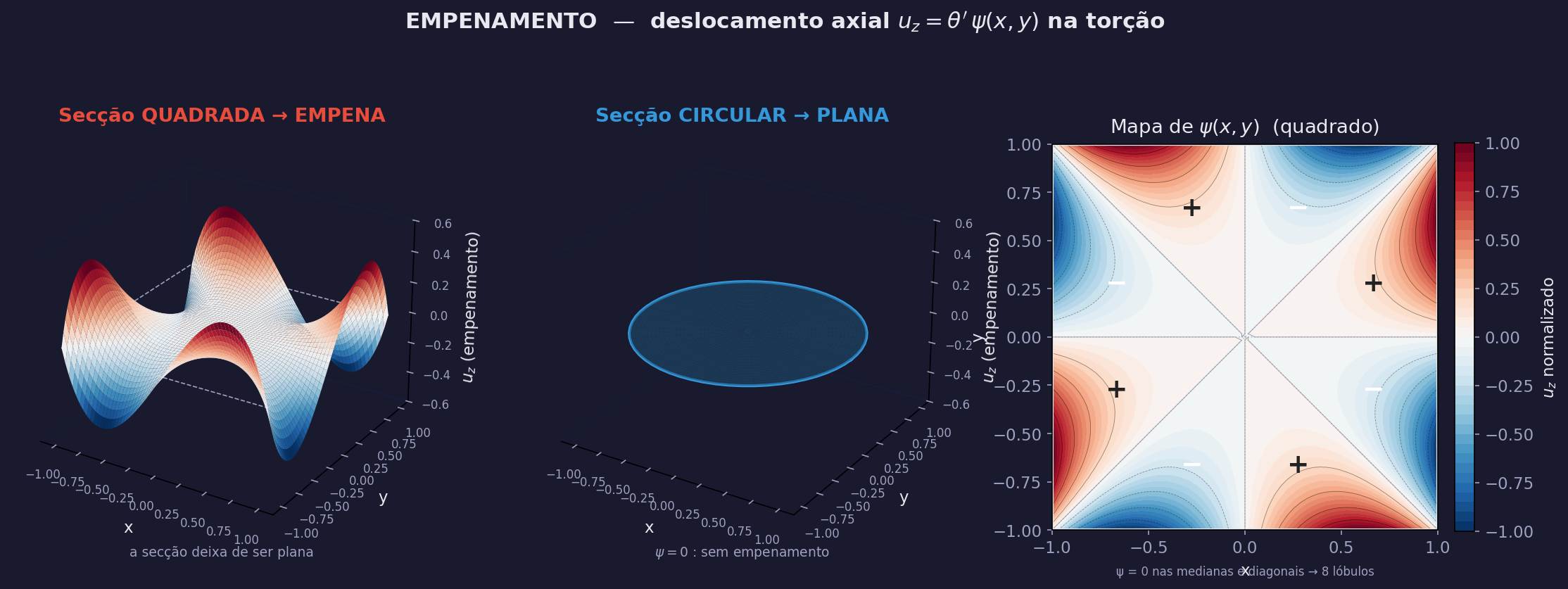
The renders above go one level deeper, from internal forces to stresses. On the left, how the bending moment and shear force of a simply supported beam distribute across a rectangular cross-section: normal stress linear in height (σ = My/I), shear stress parabolic (τ = VQ/Ib). On the right, St. Venant torsion warping — a circular section stays plane under torsion, but a square one warps out of its own plane.
Rocket Flight Simulation
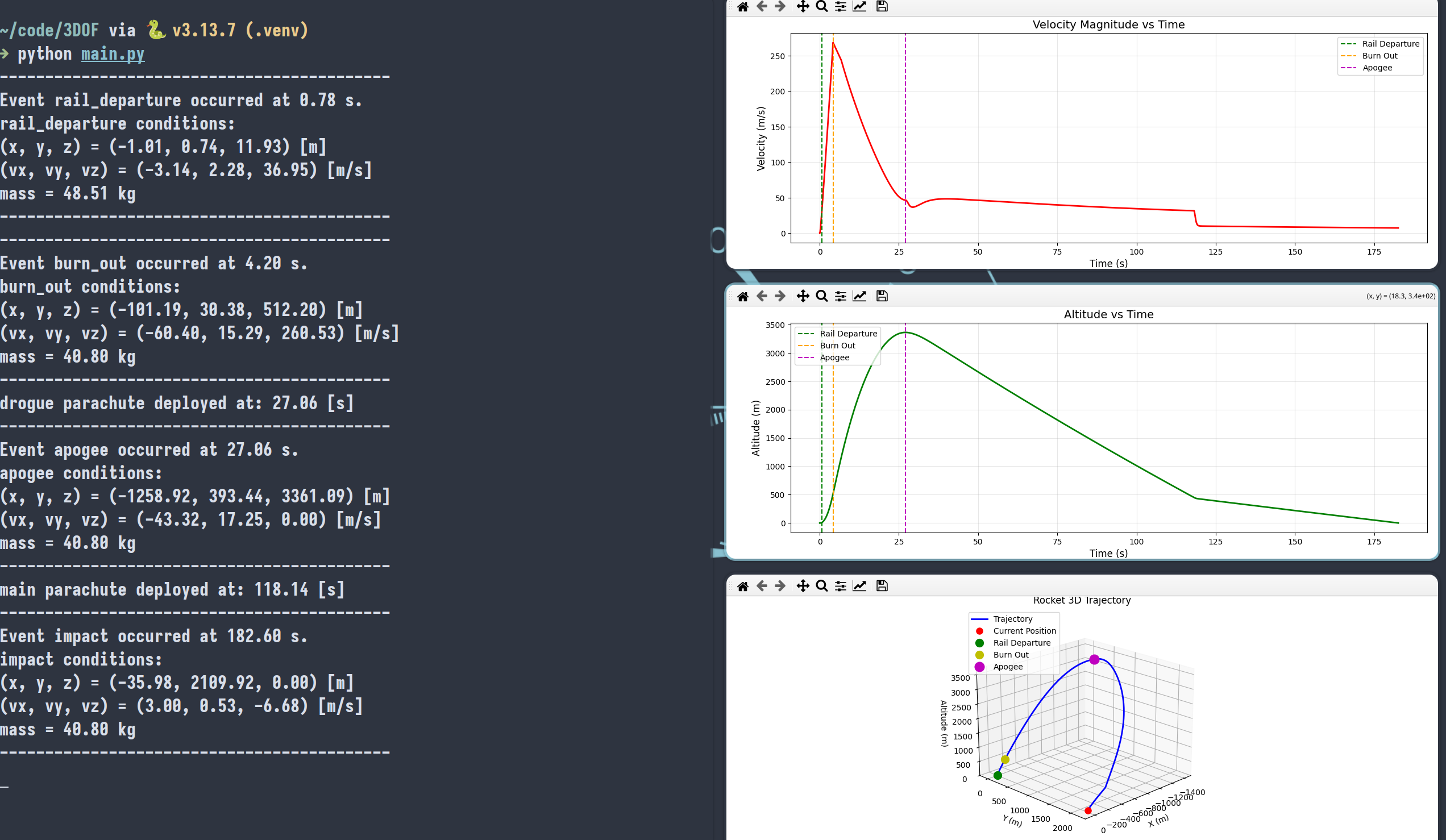
Flight simulation work for INVICTUS II, our student rocket for EuRoC. RocketPy 6DOF simulations verify the launch requirements before anything flies: rail-exit velocity of 32.8 m/s (the competition requires 30), a predicted apogee of about 3 150 m AGL against the 3 000 m target, and a stability margin that stays close to 3.9 calibers through the burn. The plot above is from Flight Forge, a lighter 3DOF simulator we wrote for the early design phase, when you don't yet know the inertia tensor but still need fast answers on apogee, rail-exit speed and parachute descent rates. Rounding it out, OpenFOAM CFD runs of the airframe at 30–240 m/s feed the drag data.