Module 2 of many
Monolítica at Aloft
Monolítica. The team I’m working with. We are a decent group of engineers, with varied qualities and skill sets, which allow us to understand and approach complex problems and industries in unique ways.
We want to make manufacturing cheap and quick, because the entire economy depends on that. You make goods cheaper, people can buy a lot more with a lot less. It’s the inversion of inflation. Quite simple.
How do we approach this? We speak with factory owners, they let us in, we get to interview everyone, understand what kind of information goes around, where it comes from, where it goes. Cotton eyed joe.
This week our work is at Aloft, a shoe sole factory in Vila do Conde. They are a very big and rapidly growing factory, despite being extremely remote. Building around sustainability and an experimentation-focused culture made it attractive to many of the talented people we met, who were able to very clearly explain to us all of their workflows.
Doors Wide Open
Aloft gave us full freedom, without ever having seen any of our work. Their growth is no surprise to us. The freedom we were given allowed us not only to be able to help them with their specified problems, but also to be creative, to think of connections in processes, to understand in a day what would otherwise take a week or a month even.
Creativity Is Cultural
Although we were there to solve a human resources problem, the openness everyone had to us allowed us to simultaneously develop a more general vision, one into which this HR platform fits, in a way that is actually productive - that generates value for them, which is exactly what we want.
Their own team, we noticed, were comfortable, free, and responsible enough in their work that they themselves were trying to solve the problems they were describing in creative ways. This is cultural. We know that it is not just in the back-office either. Aloft developed EBLAST, an injection method that allows Europe to compete with China for sole weight.
Where the Time Goes
The freedom and responsibility we all felt provided for amazing synergy between our team and theirs. We were quickly able to understand how things worked.
The back-office team uses five different platforms to organize themselves, but they really just want to use Excel for everything. TOC Online is the platform they use for paying their workers, Idonic is where they count work hours, WinGIIC is the ERP (both the old and the new versions are in use) where receipts and orders are registered, and they have an internal platform AloftApp, where they manage production and planning and give prizes. Let’s count the Microsoft platform as one of them: Excel, emails, etc.
A lot of time is wasted in between these five platforms. As Dina, who runs payroll, put it: “I lose far too much time.”
First of all, there is no connection or sync between any two of them. Everything is filled out by hand, and because that is the situation, and because all the accounts have to be right, everything is validated after inserting to the platform too.
Secondly, they don’t know each workers’ skill sets, the required skill sets for each factory unit, they don’t have documentation describing each function and a signature by the worker to acknowledge that’s their function.
Then, awards that come from AloftApp also require hand-filling into the payment processing at TOC Online; times have to be filled in from Idonic to TOC Online, then filtered manually by extra time, night shift, weekend hours, so that TOC Online can calculate the correct values.
Everything is, finally, validated manually, and the receipts are sent to the financial department to go into the ERP and the Excels.
That’s timekeeping. Then HR takes care of applications and onboarding. Each onboarding has an email intro to the team the day before they arrive, then a certain amount of hours they need to spend with certain people (who need their calendars reserved at those times), mandatory training.
One of the main issues for member management was incomplete data. The data is all kept in an Excel, and that excel needs to be updated and completed with the missing information.
Anonymous feedback is a useful feature for HR here too, because it allows teams to give opinions about each other without confrontation.
The Finance and Treasury department also spends considerable amounts of time validating information. All the purchases, agreed deals vs. real invoices, making monthly accounts, payments three times a month (on the 10th, 20th and 30th), constant communication with the CTO for all payments, getting updated price tables by email, having to update the ERP (WinGIIC) Technical Sheets with new prices, coordinating with manufacturing planning to buy material and get deliveries in time, partial deliveries, communication with providers more generally (negotiating prices, etc).
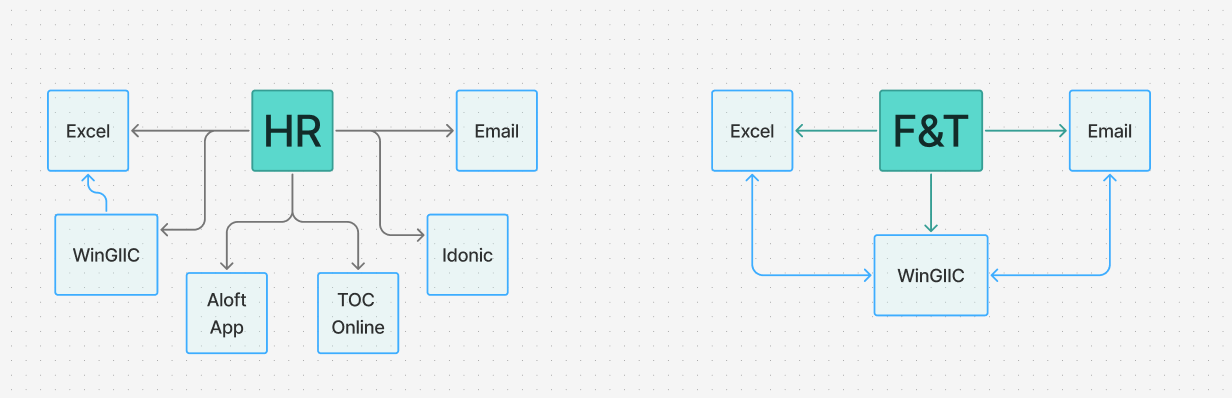
The Temptation to Solve Everything
These are very well described problems, and for us engineers, knowing the capabilities of modern-day information and communication systems, ideas bubble up like soap bubbles. We want to solve them all, because they seem so easy to solve - because we see the amount of repetitiveness there is in this sort of work and that in just a few hours we could make something that does that work forever.
The issue is that there are other challenges. Adoption is the main one, which is the same as the user’s trust problem. This is the most complex problem to manage, especially if you’re trying to systematize everything at once. It’s just going to end up in a contest. It’s like forcing someone to move out of their home, or better, losing your home to a storm. You’re left with nothing, no skills - the thing that got you the job you have is gone. It’s breaking an important foundation. It’s crucial to address the adoption issue, and it is generally addressed through training and incentives.
There are several solutions we could develop between Finance & Treasury and HR; it is important to choose one to gain people’s trust. The main question is trust, and it has to be addressed by starting small. For us it makes sense to invest our time on whatever will take the least time and cost - the simplest solution -, because Aloft are paying the cheapest rates now, and because it’s least likely to break and make us lose their trust.
There are a few solutions that I imagine could be done here:
-
In HR, we could make the recruitment and onboarding normalized triggers and actions. Sending out emails informing teams they will have a new member. Scheduling training, associating a trainer, and all the trainees, and blocking calendars. Sending out documents by email to the relevant people where they can sign that they did training, for legal accounts.
-
ERP Hygiene and Management - send out forms to complete all the missing data from the main Excel database they’re using for HR. Map out every function in the factory and define everyone’s skills. Have function forms (sent and acknowledged by email) where the workers declare that they agree with their job function.
-
Anonymous feedback forms inside the company.
-
Relatório único (take the necessary documents from the “Custos” excel and generate the report) - done once a year.
-
Timekeeping and filtering through cronjobs for Idonic and data labelling for TOC Online to know daytime rates, nighttime rates, etc.
-
Now for F&T, syncing WinGIIC with Excel
-
Verifying prices from emails, validating that the providers are being consistent with pricing. Paula showed us the live version of this: an order placed at 27.08, invoiced at 27.17, an email sent, an answer still pending. In her words, “it’s not so much posting the invoice that takes the longest — it’s the validation”: going through the file, checking whether it’s right, complaining when it isn’t.
The problem we pick will be in HR, because the issue is more complex, and the path to the greatest evident effect is in that department, and because some of the developments we eventually make in HR, such as agent-based validations or information sync between the platforms and Excel, are easily transposable to accounting. Since we also want to gain their trust, we want to do something that we know we can do. And because we want to be valuable to them, we want them to recover the investment — a €5k payment — within six months at most, and to double its value within a year.
I propose Monolítica’s solution to include points 2, 4 and 5. The transcripts mostly back this up. Timekeeping is the best-evidenced time sink we recorded — Dina’s whole processing ladder is quoted below. The Excel hygiene problem is just as explicit: completing the workers’ database means going dossier by dossier — “otherwise I’m spending my time twice”, as Dina put it, which is why she keeps postponing it. Honesty forces one note: the relatório único is the one item nobody complained about on tape. It stays in the package not because it burns hours, but because it is cheap to automate and errors in it are expensive — the fines are below. And if we ever swap a piece based on pure time-saved evidence, the strongest candidate is Paula’s duplicated purchase approvals (“the fact that we have to duplicate the information here and here immediately eats a lot of time”), the clearest Finance & Treasury sink for a second phase.
Three Small, Useful Things
To solve the ERP hygiene and management we’re going to have to retrieve requirements from Filipa, then create forms, print out papers, distribute them around the factory, and speak to the relevant managers to give them the responsibility of making sure that that happens. A big piece of added value is that everyone’s skill set gets parametrized.
For the relatório único it’s just a question of creating a script that reads the Excel and exports a PDF.
Punch records (picagem de ponto) will be the most complex one, and where the most value will be obviously seen. We will have read and write access to the SQL database, and will read times, pay rates, salaries, and exceptions such as holidays or sick days. These exceptions are described in Portuguese law, and what happens on Idonic has to be cross-checked against what the payment represents.
Each of these three gets a goal we can be held to — numbers to be validated with the Aloft team before we commit:
-
ERP hygiene: the HR Excel complete for all 160-odd workers — no missing fields — and every function in the factory described and signed by its worker, within eight weeks of kick-off.
-
Relatório único: generated from the “Custos” Excel in one command, needing under an hour of human review, ready before the next annual submission window.
-
Punch records: payroll processing down from the current three-to-four days to one day in the first assisted month, aiming at Dina’s own best-case estimate — about one hour — by the third.
There will be great time saved with these solutions — and we don’t have to guess how much, because the team told us. Dina, on payroll processing: “right now it’s three or four days, back and forth” — the validation alone “takes me at least half a day”. With clean data, in her own words, “I do the whole thing in one day”; with automatic alerts, “maybe one hour”. The monthly prize file from AloftApp “has no formulas. It’s 100% manual… every month I have to fill this in and key it in here”. And Filipa calls the onboarding calendar-blocking “a bit exhausting”, one agenda at a time. (Quotes translated from our meeting transcripts.)
Put a salary on that: two to three days recovered per month is roughly 10–15% of a full-time role. Michael Page’s salary study puts an HR technician in the Porto region at €11,200–€24,500 gross per year, so the payroll ladder alone is worth on the order of €1,500–€3,500 a year — before employer contributions, and before counting the prize file, the missing-data chase and the onboarding scheduling. An estimate to validate, not an invoice.
Then there is the cost of getting it wrong. The relatório único will be delivered either way — the question is what errors in it cost. A report delivered late, incomplete or with wrong data is a serious labour offence under article 32 of Lei 105/2009, with fines set by article 554 of the Código do Trabalho that scale with turnover — from about €600 to nearly €9,700 at 2026’s unit value, and there is case law of an €8,160 fine upheld on appeal in this family of offences. Generating the report straight from the source Excel removes the manual transcription where those errors are born. Filipa also reminded us that in an audit, “9001 or whatever, they’ll go straight for” missing function documentation. (Fine values move with each state budget — for Aloft’s certified accountant to confirm.)
Errors carry a price even without fines. An EY survey — commissioned by a payroll vendor, so keep salt at hand — found about one in five payrolls contains errors, at an average cost of $291 each; Deloitte’s payroll benchmarking with the American Payroll Association found 30% of organisations name manual entry of payroll inputs as the most time-consuming part of the whole process — precisely the part we are removing. Paula’s side of the house has the same shape: payments are checked “a bit by eye, and sometimes a supplier payment slips through”.
The case rests on two things: the industry benchmarks above on where payroll time actually goes, and the ladder Dina herself gave us — three-to-four days today, one hour in the best case. That’s a ~95% reduction, estimated by the person who does the work, not by a vendor.
Truth-Based Decisions
I think it’s pretty simple how this simplifies the lives at Aloft, but it is important that it simplifies Pedro’s life. Why is it of value to Pedro to have HR running smoothly? He wants to know everyone’s skill set, he wants to know what the limitation for his company is on the growth side. Find gaps in the company’s skill range. This requires a description of every function inside the company, which is something Filipa (HR) is doing already, and something we can speed up with a few hours on the factory floor mapping out skills, and showing it to Pedro on an Excel.
We’ve described how this simplifies the HR team’s job, and how it simplifies Pedro’s life by giving him the data he needs to make truth-based decisions. He told us as much on day one: the projects that get his attention are the ones where he can see “this is going to simplify my life a lot — keep it simple”. And truth-based decisions are no abstraction to him; this is someone who records his commercial negotiations because “our memory rewrites the past. Always.” The recording doesn’t. But how does this fit into Aloft’s goals?
Aloft is built around sustainability and growth — and that’s measurable, not brand copy. Their EBLAST expanded-polymer soles weigh 110–120 grams where a standard sole weighs around 200, developed under the BioShoes4All project, and the partnership with Decathlon produced sneakers assembled entirely without glue; weeks later they were investing in micronizing rubber waste back into secondary raw material. A factory operating at that level on the product side deserves a back office at the same level — and removing manual work there is exactly the direction the OECD keeps pointing Portugal in: the 2026 Economic Survey of Portugal places Portuguese labour productivity around 17% below the OECD average, with uneven digital adoption carrying much of the blame, and the OECD’s SME digitalisation survey finds the digital gap between smaller firms and large ones still widening, with time, skills and money as the main barriers. What we’re doing at Aloft is that agenda, made concrete.
The Path to the Factory Floor
This is good for us too: we get to understand how the Aloft system works and identify the gaps in the system itself. That’s what we are good at. Since we offload a lot of “raw intelligence” to AI, our value is in discerning what is useful and what isn’t. This becomes a base of knowledge we can keep growing, and it makes us better at doing this work.
We also see a clear path to expansion once we’ve gained Aloft’s trust—especially into manufacturing planning, which is where we ultimately want to operate. Monolítica’s future is on the factory floor: building systems and data first, then sensor systems and actuators.
That sequence matters. The “lights out” phase needs reliable historical data. Without it, you can’t tell where variability is coming from, what should be standardized, or what should be eliminated before automating.
A concrete example: in Sorema, ~80% of the SKUs generated only ~15% of revenue (and many likely weren’t profitable). That kind of complexity should be reduced before any serious automation—but you only find it once you have the right data.
We think we can make a real difference at Aloft, and are excited to work together.
Machines Serve People
A word to Pedro Castro and the team: thank you for trusting us with the freedom to explore the factory. We understand the alignment problem with AI, and we know we have a role to play. Machines serve people; people never serve machines. That’s how we’re building this: never harming people for the machine’s gain. We are not HAL.